Wednesday #Poetry: Dual, Identical, Volley

Welcome to my regular Wednesday poetry corner, brought to you by Three Word Wednesday and One Shot Wednesday.

Today's words are dual, identical, volley.

Though the sound is identical, fool,
You can't challenge me to a "dual"!
This back-and-forth volley
Is less than a folly,
So go off and wipe up your drool.

===== Feel free to comment on this or any other post.

Announcing the Best of FridayFlash, Volume 2

Every Friday, writers around the world post stories of ~1000 words and share them using the #FridayFlash hashtag. For me personally, the #FridayFlash stories have been opportunities to experiment, stretch and grow as a writer. This weekly writing commitment has also been a terrific means of making connections with other writers.

With that in mind, it's my pleasure to echo the announcement of the call for submissions to the new anthology, Best of Friday Flash, Volume 2. I have the honor of serving as a co-editor of this anthology, along with Rachel Blackbirdsong and Jon Strother, the creator, godfather and guiding light of #FridayFlash.

Submissions are being accepted as of right now. Head on over to the new FridayFlash.org website to check out the submission guidelines. I look forward to reading your stories!

p.s. If you'd like to get a sampling of the kind of writing generated under this hashtag, be sure to pick up a copy of Best of Friday Flash, Volume 1. You'll love it.

===== Feel free to comment on this or any other post.
Announcement tomorrow

I'll have something to announce tomorrow, but not until then.

In the meantime, you may enjoy this video of dramatic typing scenes.


... and thanks to Olivia Tejeda for reminding me of this one:


===== Feel free to comment on this or any other post.

e.books and self-publishing: point and counter-point

POINT: Joe Konrath has posted the text of his long and informative, even fascinating discussion about e.books and self-publishing with Barry Eisler. Summary: traditional publishing is dead and the future is indie digital.

COUNTER-POINT: John Scalzi has posted an electronic publishing bingo card, which lifts up the rallying cries of the e.book and self-publishing proponents much the way clay pigeons are lifted up at a trap shoot. Summary: traditional publishing is dead and the future is indie digital, my ass.

===== Feel free to comment on this or any other post.

Fiction Island

This was pointed out to me in a tweet by NaNoWriMo: Jasper Fforde's Fiction Island Map from "One of Our Thursdays Is Missing".

Click to enlarge


===== Feel free to comment on this or any other post.

#FridayFlash: Wish Me a Wish

Wish me a wish

by Tony Noland

I'm going to tell you a true story. Once upon a time, not so very long ago, perhaps ten years, perhaps twenty, perhaps more, a leprechaun became trapped beneath a fallen oak. Now I know you're thinking that this must be a fairy tale, what with a stuck leprechaun. Everyone knows that any of the Folk can crouch unseen behind the smallest toadstool, or slip unheard through the narrowest chimney crack. And so would this leprechaun have winked himself out of his dilemma, were it not for the thick vines of mistletoe that wrapped the trunk around. There's no magic on earth can overcome the disabling power of mistletoe, not even the dance magic of the Folk. So there the little man was, pinned by his ankles.

Oh, for all the good it did him, he cried out his little "Help, help!", that is, after he'd cursed and fussed awhile, trying to get free on his own. Proud as all leprechauns are, he was loathe to betray his distress to one of his kin or kind. An uncharitable person might have given a laugh to see the little man struggling to free himself, trying to dance up a spell with both feet pinned hard to the ground. After a bit he was still and sorry for himself, but yet unwilling to call out.

Still and all, after three days under the oak, he was out of tobacco and developing a powerful thirst. At last, it was "Help, help!", cried he, and for answer came only the silence of the forest earth and the foolishness of sparrows and squirrels. For a day and a night he called and cried until his voice fell still in his parched throat. It was another two days beyond that when the human can upon him.

It's only the foolishness of those who don't know any better to say that you can't see a leprechaun except by the light of the full moon. You can see any of the Folk in broad daylight, if they choose to be seen, for some reason, or if, as was the case with our friend, they are too weak to hide. In the light of day they look just as you might think they would, though perhaps not so thick around the middle. Also, beards went out of fashion among the Folk some generations ago, so you'll not be surprised to hear that, although our friend wore his hair fashionably long, he was bare of chin whiskers. Thus was the sight as greeted the eyes of the human, and thus the vision as what he contemplated for a good long while.

After he'd completed his contemplations, for such scenes as this are not likely to occur more than once in any human's life, he tried to shift the oak. A dozen strong men in the prime of life and health might have managed it, but one man alone could do nothing solely with the strength of arms. Fortunately for our trapped little friend, the human was a native Irishman, and therefore clever and resourceful as well as witty and a fair dancer, all such native talents being universal among his kin and kind.

Round about him he cast for a stout branch and a large stone. These he arranged just so, and, using the full weight of his body on the long lever, wedged up the trunk enough to slip a smaller stone beneath. Inchwise, lift by lift, the human worked the trunk up and up, kicking his smaller stones beneath until the gap was large enough to permit the withdrawal of the leprechaun, said withdrawal done by the collar of his coat.

For an hour or more, the human tipped water from his own supply, first onto the lips of the little man, then down his throat, giving him the balance of that bottle and the other one besides. As a nurse with a sick man did he share his water, and as one friend with another did he share his chocolate (though it was Dutch) as well as his tobacco (though it was American).

When the leprechaun was quite recovered from his ordeal, which, given plenty of water, chocolate and tobacco, was about as quickly as you might imagine, he set about to discharge his debt to the Irishman. A wish he offered and a wish he insisted the human take and use, despite protestations that no debt was incurred for "individualized humanitarian aid", the Irishman's queer way of describing his Christian charity. Finally, after a long while of offering and declining and insisting and such like and so forth, the human agreed to make a wish. Being an Irishman, as I said, he was clever and resourceful, witty and a fair dancer, but, being a young and idealistic Irishman, he was not nearly wise enough to know what to do with a wish. His heart full of beneficence, he wished that his country and his countrymen would all rise in the world and grow wealthy.

The leprechaun, however grateful though he was for his rescue, was also deathly tired from his ordeal and, I'm sorry to say, more than a bit irritated with the human for the haggling over how he should discharge his debt of honor. Had he been in a better mood, he might have granted the wish in a different manner, but perhaps not. The Folk are a tricky lot to deal with. With a wave of his hand and a few dancing steps on his sore, sore feet, the leprechaun cast the spell to make the human's wish come true. Then, with a bow that was a trifle more abrupt than it need have been, he vanished, leaving the human alone in the remote woodlands.

Days and months and years went by. The Irish, who had had centuries to learn how to be poor with dignity and grace, and in fact made the finest poor men in the world, suddenly had to learn how to be first comfortable, then wealthy. The Green Tiger was abroad in the world, and the Ireland in the days of the little man's magical wealth was a place unrecognizable to the grannies and graybeards, clucking their tongues and shaking their heads over their tea and biscuits.

Then, as it always does and always will after one season or several, the leprechaun gold vanished. The Irish, who had had only a few years to learn how to be rich, had to learn how to be poor again, and that's a lesson that's harder to learn the second time around.

So there's my story, as true as the grass is green, with the evidence of your own eyes to tell you that it's so. Let that be a lesson to you, my children. When a leprechaun offers you a wish, ask for wine or whisky, ask for a sunny day or a good meal or a good night's sleep, but never, ever, ever ask for gold.

===== Feel free to comment on this or any other post.

Bread and coffee - St. Patrick's Day in America

I present for your virtual delectation the loaf of Irish soda bread I just took out of the oven:

Flour, salt, soda & buttermilk. As it should be.

Here's a great piece about Irish soda bread, and why the sugary, raisin-bedewed confection you usually see here in the US isn't much like the way it is traditionally made.

Happy St. Patrick's Day, everyone.

===== Feel free to comment on this or any other post.

Where do ideas come from?

Today over at Write Anything, I talk about where ideas come from. More importantly, I give some suggestions on how to get through those tough times when you don't have any ideas.


How can a wasp leg help you write prose that sings and stings? Read on!

===== Feel free to comment on this or any other post.

Wednesday #Poetry: Breeze, Mellow, Tickle

Welcome to my regular Wednesday poetry corner, brought to you by Three Word Wednesday and One Shot Wednesday.

Today's words are breeze, mellow, tickle.

Earthquake, tsunami and meltdown,
Poison breeze, feel the cesium pelt down,
Has death's burning sickle
Stilled mellow laugh's tickle,
Fukushima forever a felled town?


This week's limerick isn't at all humorous. I've often wondered if the limerick form, which is traditionally associated with snappy one-liners - funny, ribald or both - can be put to a more serious use. Can the limerick express serious emotion, or is the reader so conditioned to expect something funny that they can't help but wait for the punchline?

Donate to help Japan (links cribbed from OneShotWednesday) : Unicef, Mercy corps, Red Cross , Poets for Tsunami Relief

===== Feel free to comment on this or any other post.

The Great April Fool's Day #FridayFlash Blog Swap - FAQ

Friends! Romans! Countrymen! Lend me your ears!

Tomorrow, I'll send out the pairings and prompts to all the #FridayFlash authors who will be swapping blogs on April 1, with instructions to keep the actual pairings a secret until the posts actually go up. On that Friday, you as a reader will go to the websites of your favorite authors and be face-to-face with stories by your other favorite authors.

Or maybe with authors you've never heard of before!

For any of the authors involved, or for anyone else who might be interested, I've put together an FAQ in connection with this.

Q. When can I sign up? Until midnight, EDT, today, March 14.

Q. How will I navigate all of this? On Friday, April 1, I'll post a list of all of the authors, arranged in their respective pairings, along with the writing prompt the pair was given. It'll have links so you can see how each writer responded to the prompt - embraced it, riffed off it, ignored it, whatever.

Q. My swap partner and I are in different timezones, and Friday comes much earlier for me than it does for him/her. When should we post our stories? The #FridayFlash community is spread around the globe. One person's Friday morning is another person's Thursday afternoon. So, for the purposes of this blogswap, stories may be posted when Friday, April 1, 2011 comes to the blog that's EARLIER in the pair. For example, two writers, one in London, one in Los Angeles, would both post their stories when April Fool's Day hits London. If the London author is paired with a writer in Sydney, then they would both post when April Fool's Day hits Sydney.

Q. That sounds really complicated. Can't I just post my partner's story at the same time I would usually post my own? Oh, very well. Negotiate between the two of you and post them whenever you want. It's not like I'm going to come take your lunch money if you do it differently.

Q. Once I've read the swap story on my favorite author's blog, how do I find the story written by my favorite author? Each pair of authors will provide mutual links between the stories, as well as back to the index of all the stories. Who knows? Maybe by reading the swapped story, you'll discover a new author to love!

Q. Do I have to pretend to be the person I'm swapped with? i.e. do I have to write in that person's voice? You can if you want to, but no, it's not required. Some folks might be intrigued at the challenge of trying it, perhaps in taking some of their characters into a new dramatic situation, or writing in their partner's preferred genre. Otherwise, just write your story and have fun!

Q. Who gets credit for the story? Me, because I wrote it, or my partner, because he/she posted it? You get credit for your own work. Consider this a mutual guest posting.

Q. Can I write about cats? Yes.

Q. Will you yell at me if I do?*sigh* No, I won't yell at you if you write about cats.

Q. Can I tweet about my cat-themed story? Look, go back and read the damned post, OK? I never said I didn't like cats! Now, can we PLEASE get back to the questions about the Great April Fool's Day #FridayFlash blogswap?

Q. So it's OK to tweet about cats again? [this question deleted by Tony for being off-topic]

Q. Is this blogswap authorized by Jon Strother, the Godfather and central controlling authority of #FridayFlash? Um, no. This was a product of my own fevered brain.

Q. That means it isn't authorized - you can't do something that isn't authorized! First of all, I guess I kinda did already. Second of all, that wasn't a question, it was a statement. You're lucky I even let it into the FAQ.

Q. What if the person I've been paired with uses a lot of profanity in their writing? Or otherwise writes a story that I don't feel comfortable putting up on my site? By participating in this blogswap, every author should understand that the story you write will be posted on your colleague's website. Be respectful of that environment, and be a gracious guest. We're all adults here, so each pair of authors should be open to discussion of decorum. No one should feel under compulsion to unduly sacrifice artistic freedom as a writer OR be unduly beholden to piss off their website's readership as a host.

Q. The two of us tried to negotiate on this, but can't come to agreement. What now? In cases where a random pairing of authors just doesn't work out (e.g. "sweet, slice-of-life kittens and lemonade" paired with "cannibal horror sex liberal snuff couplings"), let me know and I'll try to reshuffle the author list.

Q. Who logs my story in the FridayFlash collector? You do. It's your story, so you should enter it in, using the URL of your swap partner's blog. Remember to use the specific post page your story appeared in, not the general one for the entire blog.

~~~~~~

Any other questions? Leave them in the comments and I'll answer them here.

===== Feel free to comment on this or any other post.

Wave propagation

From NOAA comes this video of the March 11 tsunami, a visualization of the wave's propagation that is astonishing when you consider that this is a video of HALF A PLANET. Incredible.


In the comments, you can insert your own literary metaphor interpretation of this.

===== Feel free to comment on this or any other post.

#FridayFlash: The One Thing You Need To Be Happy

The One Thing You Need To Be Happy

by Tony Noland

"Only one thing? It'd take more than one to make me happy." With a flick of his wrist, the empty bottle flipped end over end, smashing against the concrete wall in a disintegration of green glass. Shards flew outward in a parabolic shell, rebounding off the wall, raining down into the pit. He took another empty bottle from the case, drew back for another throw. "A miserable son of a bitch like me? More than one thing, that's for damn sure." His tattooed arm winged forward and another perfect shower of broken glass erupted and fell.

"There's gotta be something, Stick. How about a winning lottery ticket?" Manny leaned against the steel fence, watching the bottles explode. Stick drank Rolling Rock, not because he particularly liked the taste, but because the labels were printed on the glass. He said it made the bottles break better than most brands, with their glued-on paper labels. Having lobbed many kinds of bottles into the recycling pits, Manny had to agree. Once you'd gotten the hang of smashing empty Rolling Rocks, nothing else came close in terms of destructive satisfaction.

"Nah, I don't want no lottery ticket. If I won a hundred million dollars, I'd just quit working and drink myself to death." One foot canted outward, Stick whipped an empty sidearm. It curled in the air before shattering against the left sidewall of the green glass pit, just ahead of the corner. The fragments smashed off the sidewall, pounded into the back wall and arced upwards in a flat spray, a plane of glinting green light that sliced downward in a line. "As it is, job gives me somethin' to do. I gotta get up every morning to go to work. Beer money don't grow on trees."

"How about a woman? A good woman, not like you-know-who."

Stick's hand paused over his case for a moment, then pulled another empty. "Nope," he said, "a woman ain't a thing. She's a lotta different things, a buncha things that change from one day to the next. We're talking about one thing, just one thing you need to be happy." He considered his throw carefully. With a soft, spinning lob, Stick made the bottle pop against the back wall, mouth end first. The lip and neck cracked off, leaving the intact bottom to drop downward. It impacted into a big, unbroken wine bottle, a thick-walled gallon jug. The beer bottle bounced upward in five big pieces, the chunks arcing outward in a star shape. Stick laughed. "You see that? Did you see that? God bless Earnest and Julio Gallo, huh? That was beautiful!"

Manny clapped his hands softly. "You've got the touch, man. You shoulda been a pitcher."

Stick grunted and spit into the pit. "Pitcher? Like as in a baseball pitcher? Bullshit. A newspaper delivery guy, maybe, throwing papers onto porches out in the suburbs, but a baseball pitcher? Bullshit." He waved his hand dismissively, but smiled as he did so. He looked down into the box at the last empty bottle. This was the last case, too. Once that bottle was gone, it would be another month, maybe two before he came back to the municipal recycling center.

"I always hate to throw the last bottle," Stick said. "Pathetic, huh? How frickin' sad is that, a dumb bastard so far gone that smashing beer bottles is the high point of his life?" He held the bottle for a moment, then threw it backhand against the wall. It shattered as beautifully as all the others had, a perfect starburst of fragments flying upwards, shining in the sunlight before falling into the pit, there to be lost amid all the other bottles and jugs, broken and unbroken.

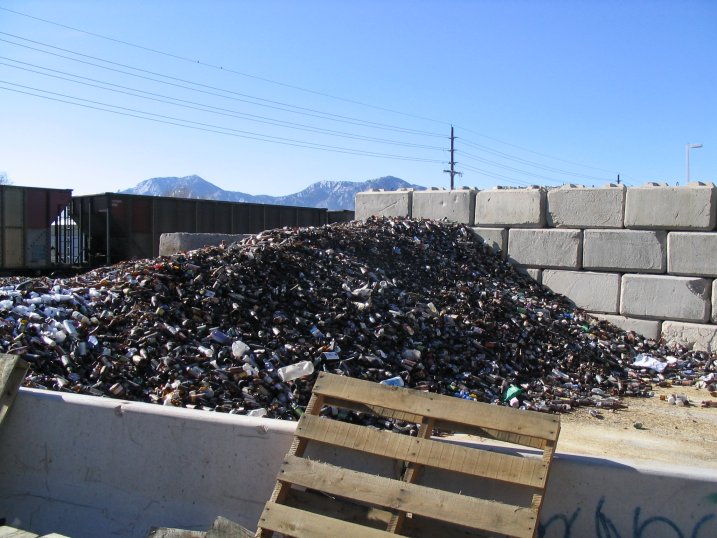
They stood for a while, listening to the near-silence of distant seagulls on the landfill. Without the sound of their own bottles drowning it out, it was just possible to hear the soft, grinding groan of the glass, shifting as it settled down in the pit. Green glass, brown glass, clear glass... they all shivered and settled in their respective beds, coming to a deeper resting place, rocked by the subterranean vibrations of the shredders in the metal shed.

"Come on," said Stick. "Let's get out of here." They picked up the empty cardboard cases and tossed them in the back of Manny's truck. All the newspaper and cardboard would go into the bins by the exit. Manny started the truck, but didn't put it in gear right away.

"OK, how about this. How about if it's not, y'know, globally happy, not perfectly happy in every way, forever and ever, amen. Instead, let's say... kinda happy." Manny waggled his hand. "Or maybe perfectly happy, but just for a little while. How about that?"

Stick considered this. "For like, what, a day?"

"A day, an hour, whatever." Manny put the truck in drive and drove toward the exit. "It's gotta be one thing, though, just one thing."

With the radio playing and the trash-scented breeze moving through the open windows, Stick considered what the one thing might be that could make a man happy, even for an hour.

===== Feel free to comment on this or any other post.

From Gilgamesh to Galactica - a historical map of science fiction

 This is pretty awesome. Original link.

If ever there were an image to click, enlarge and study, this one is it.


===== Feel free to comment on this or any other post.

My story is out at Escape Into Life

One of my stories is up over at Escape Into Life, entitled "Straight and True, My Arrow, Fly". If you only know the watered down version of the Greek god Eros, the cherubic little homewrecker that the Romans called Cupid, then you should read this story. The theology associated with Eros was a complex and detailed one. Here, of course, it's dramatic and bloody.

Enjoy!

===== Feel free to comment on this or any other post.

Wednesday #Poetry: Dainty, Haunting, Tantalize

Welcome to my regular Wednesday poetry corner, brought to you by Three Word Wednesday and One Shot Wednesday.

Today's words are dainty, haunting, tantalize.

E'er haunting the dark stygian deeps
The thirsty man Tantalus weeps
No dainty tears here
'mid water so near
To tantalize just out of reach.

Why not listen to me read it? It'll be the best 12 seconds of your day:

Listen!

===== Feel free to comment on this or any other post.

Before there were e.books, there was linotype

Back in the old days, printing was done by setting individual typeblocks in a frame, one block for each letter, number, punctuation mark and space. Even in the hands of an experienced typesetter, the process was relatively slow and prone to errors. The type was all backward in the frame, so spotting typos was tricky. One especially pernicious typo was the substitution of "p" for "q", since they are mirror images of each other in many fonts. Hence the origin of the phrase, "mind your p's and q's".

This system also meant that a printer had to have many, many thousands of individual pieces of type, enough to print an entire newspaper. After the day's printing, the frames were broken up and the letters redistributed, ready to be used again. Similarly, books were printed in jobs of some defined number of copies, then the type was reused elsewhere. Printers couldn't afford to leave type framed up for very long, since it meant having a big chunk of type inventory unavailable for other uses. As it was, the inventory of type was a significant part of printing.

Then, in a rush of technological innovation came LINOTYPE. It's pronounced LINE-O-TYPE, since that's what it did: make an entire line of type in a single, freshly cast piece of metal, called a slug. An operator typed in the text of the line, ready from a normal piece of copy, and the machine cast the line of type. The molten tin cooled while the operator was working on the next line. With the pull of a lever, the finished type slid down onto a frame, automatically in perfect position for loading into the printing press. The line could be in your choice of fonts or mixtures thereof, with specialties of bold, italics, etc. available with the push of a button.

You could set as much type as you wanted, and keeping a frame of set type in the warehouse didn't prevent you from casting more type for other print jobs. When the print run was finished, the type slugs were plopped back in the feed hopper where they were melted down and re-used. It wasn't exactly Print-On-Demand, but there are the same concepts at work.

It took a while for this technological innovation to evolve and mature, and even longer for the traditional publishing houses to adopt it. They'd invested millions in type inventories, old-style printing presses and employees who knew how to run them. Making the change took generations, and there were still publishers who insisted that the old ways were better. In this environment, newer and smaller houses, without the fixed costs of a legacy technology, were able to come quickly onto the scene and do smaller runs, faster publication rates. These would have been impractical for bigger houses with the older technologies, but with the new linotypes and automated presses, the game changed completely.

Before there were indie e.books, there was linotype.


===== Feel free to comment on this or any other post.

Guest blogger Trevor Mcpherson: How to use mind mapping to write a novel and capture ideas

I was recently in a Twitter discussion of mindmapping, a tool that some productivity and professional organization gurus love to recommend. I've played around with it a bit, but didn't know how to apply it. After Trevor Mcpherson offered to share a Freemind template that he uses for plotting and capturing writing ideas, I invited him to come over to Landless and share his expertise.

~~~~~~~~~~

Freemind is an easy to use and powerful tool for organizing your thoughts. Based on Tony Buzan's Mind Mapping program, it allows for a non-linear and visual organization of information. While it may not be everyone's cup of tea, it certainly offers some advantages for the writer who takes the time to learn the basics. While we're on the subject, I wouldn't recommend going much beyond the basics for the purposes discussed here. Doing so runs the risk of the program itself becoming the focus, rather than its use to organize and structure writing projects. We'll look at a sample mind map I've created called StoryMap.

StoryMap is a tool that is focused on creative aspects of writing. A great deal of the craft of is built on imagination and research. The idea behind the StoryMap was to create a document that focused on these rather than the actual typing. In short, I wanted a way to separate the making things up, and the writing things down. This is what the blank copy of StoryMap looks like:

Click on the image to enlarge. The little circles at the end of a fork indicate a collapsed node.

Right about now the free-spirited and artsy-fartsy in the crowd are likely thinking 'No way man! You establishment types can NOT force my creativity into a formula, man!' Well, hippie, repeat after me: Organization is not Fascism.

This tool was developed to augment the creative flow, not restrict it. A lot of my writing time was actually spent figuring out character traits and plot ideas while trying to achieve word count. This resulted in a lot staring off into space, mumbling to the cats and not getting much on the page. The word:time ratio at the keyboard was abysmal. After a week or two of this, I realized that writing and typing are not necessarily the same thing.

StoryMap evolved as a tool that would help with productivity and the division of labour (the previously mentioned making things up vs. writing things down).

The mind mapping techniques allow for a separation of the non-linear (making things up) and linear (writing things down) tasks. If food analogies work for you, think about having all the ingredients at hand and the prep work done. Character traits sliced and diced, plot marinated over night, and the dialogue spices all measured out and waiting - Just turn on the stove, and go for it.

Here are some of the ways I've found StoryMap to be useful:

AS IDEA CATCHER StoryMap allows for the filling in of what I determined to be some important blanks when creating a story. The nice thing about Freemind is that it plays nice with a handful of smart phone apps (see resource section at the end of this post). Stuck in line at the bank or jealous of how that 45 minute train ride to work cuts into your writing time? Make notes for a scene in act two, or jot down a character idea. Make that alleged down time count towards your story.

Feeling burned out, or pressed for time? Ease your creative guilt by adding to the StoryMap. You might not have the 3 hours you'd like to sit down and write your masterpiece, but I bet you could find 10 minutes a couple times a day to add to the StoryMap. When you do find a few hours to write, you'll have a deep well of ideas and notes to draw from.

AS REFERENCE POINT Freemind allows for the embedding of documents and links. There are options to add icons, allowing for further customization. A lot of your info can be all in one place, and referenced quickly when organized by character, location, objects, etc. The ugly reality is not many of us have the luxury of countless hours to get things done. The visual paradigm of StoryMap allows for a quick scan of what's done and what needs work, allowing you to choose a scene or chapter suitable to the time you have available.

AS SECOND BRAIN If you go the smart phone/app route and/or use multiple computers, consider adding Dropbox to your tool-belt. This program will allow you to keep your mind maps and writing files synchronized between all your devices.

The content of StoryMap evolved as I learned about the writing process. It will continue to change because I'm not done learning. If all goes well, I'll never be done learning. I encourage you download Freemind and use StoryMap as a starting point, and modify it for your own use.

Related Resources

Freemind Software
- the program itself. Open source and free.

UPDATE: Here's a DOWNLOAD link for my StoryMap template, made available to you through a special arrangement with Tony Noland. If you try it out, please leave a comment below.

Mind Mapping Tutorials - watch the video below for a 4 minute intro in the nuts-and-bolts of constructing, revising and customizing a map

Dropbox - a tool to share and synchronize files between connected devices.

Thinking Space - a mind mapping app for Android phones

iPhone app - here's the thing: I couldn't find a Freemind compatible app with good reviews. There are equivalent mind mapping apps available for your perusal. I didn't check them out - I'm an Android kinda guy.

~~~~~~~~~~

Trevor Mcpherson is the author of a collection of flash fiction, Something's Not Right, and has been published in the anthologies Best of Friday Flash Volume #1, and Dog Days of Summer.

He is currently at work on a time travel novella based on the Dewey Decimal System. Yeah, that's right, that's what he said - the Dewey Decimal System.

All things Trev can be explored at trevormcpherson.info.

~~~~~~~~~~
Thanks, Trevor! So, what do you think, everyone? Could you use this? Do you see advantages to doing an outline this way over a traditional "I.1.i.a." outline in Word? Does anyone have an iPhone app they'd like to share? Would you prefer a cuter, but more stripped down mind mapper like bubbl.us? Anyone have any other experiences they'd like to share? How well do you think you could you integrate a mind map with the writing?

Here's the video Trevor linked to:


===== Feel free to comment on this or any other post.

A stupid (but effective) trick to improve the editing experience

I can't believe I didn't think of this sooner.

When editing the draft of my current work in progress, "Goodbye Grammarian", I do the large-scale edits by hand on a printout of the 50K first draft. It lets me get very old school and organic with the document.

Editing a draft -BEFORE
However, it's been a bit of a pain in the neck. Minor inserts and scratchouts can be in the printed text, but anything larger needs a footnote and an expansive discussion on the left side. This means I reach over the printed pages to make the more extensive notes on the facing blank page.

What happens as I reach around and over the rings, writing in between them and around them? The ends of the sentences are crammed around the obstacles and my wrist is pinched and twisted. Granted, this wouldn't be an issue for a left-handed writer, but for me, this was distinctly sub-optimal.

Editing a draft - AFTER
Enter a flash of genius.

I took the whole stack out and punched fresh holes in the RIGHT sides of the pages, then reordered them to put them in reverse sequence, e.g. last page first. I then took the entire stack and turned it over before putting it in the binder via the new holes.

Now, the story unfolds in proper sequence with the printed text on the LEFT side. The blank sides of the pages are on the RIGHT, so I can write on them with perfect ease and comfort. My handwritten notes directly refer to the text to be changed.

On the one hand, I feel pretty smart for thinking of this. On the other hand, why the hell didn't I think of this 15,000 words ago?

Even if someone already thought of this, is this the cleverest trick you've ever seen, or what? Assuming you're going to be old school about it (i.e. non-electronic), is there an ever better trick to ease the editing process?

===== Feel free to comment on this or any other post.

#FridayFlash: The Herringbone Meteorite

The Herringbone Meteorite

by Tony Noland

His Imperial Majesty, God-Emperor Xiang Chu Siquiera Charles IV, of the Celestial House of Kaminski, asked, "What is that supposed to be? Is it a potato or a rock?"

The curator of art cleared his throat before speaking. "Your Majesty, we believe it to be a representation of a meteorite. If I may direct His Majesty's attention to the herringbone pattern?" The old man's papery thin hand waved at the case, then withdrew as the monarch leaned forward for a closer look.

"Why a herringbone pattern? This was drawn after the invention of synthetic fabrics, was it not?"

"Yes, Your Majesty, in the century following. During the first decades of the twenty-first century, animal fibers were still occasionally used in weaving cloth. Some of the more traditional patterns were still in vogue."

"I see." The Imperial eyes squinted. "Why is the meteorite covered in a pattern of a woven fabric derived from animal fibers? I see now that it's clearly a cavorite ore deposit."

The curator cleared his throat again, a slight sheen of sweat on his brow. "His Majesty may be gracious enough to forgive the foolishness of ancient artists. The proportions of the image suggest that this was not intended to be a scale-accurate representation of meteorite harvesting."

The lord of ten thousand suns frowned. "But this was done at about the same time as mankind first established the presence of cavorite in Oort cloud debris. It's a perfect picture of cavorite extraction. The electron spindle, the sonocavitation focusing crystal, even the positron-matrix webbing around the meteorite, although why it's cast in a herringbone pattern is a mystery."

The royal historian shifted slightly, a subtle invitation to be invited to speak. The monarch nodded to him and his said, "Your majesty, the first cavorite ore deposits were discovered in 2098. This drawing dates from earlier in that century, possibly from as early as 2020."

"Are you telling me it's just a coincidence? That this picture, which is a perfect representation of the cavorite extraction process, the heart of translight drive and the entire basis of our star empire, has no connection to it at all? Rubbish." He turned to the curator. "Relabel this exhibit. It is clearly an early schematic of a cavorite extractor." The curator bowed low, his face hot and flushed.

The decision made and the mystery cleared up, the monarch moved on to examine an internal combustion engine and a set of stainless steel knives, both recovered from recent archeological diggings.

===== Feel free to comment on this or any other post.

Novel excerpt: Goodbye Grammarian

The Grammarian has been trying to crack the case of a series of high-tech crimes. He fears that the fate of Lexicon City hangs in the balance. Now, we join our hero in hot pursuit of his best lead yet...

The Grammarian sped down rain-slick streets, the tires of his motorcycle sending a spray of oily water behind him. The car in front swerved to avoid a collision, but didn't slow even a fraction. Throttle wide open, the Grammarian closed the distance with every passing second. The three men robbed a jewelry store, having disabled the alarms with a set of high-tech sonic negator probes. It was like using a jackhammer to crack a walnut, and the Grammarian knew that he was onto something big. This was the third set of criminals using technology way, way above their station, and he wanted to know who was behind it.

From the rear window of the car, a shot exploded, sending a gout of yellow flame backwards. The superhero swerved, anticipating that the shot would go wild to the right. He stretched out his left hand to send a stream of sentence fragment memes forward, but releasing the brake caused him to skid on a slick spot in the road.

Under his breath, the Grammarian cursed the necessity of using a motorcycle for this kind of pursuit. The rain didn't bother his eyes or breathing - his projection field took care of that - but it made his traction less than reliable. He reached down and sprayed a cloud of metaphors at his tires. Instantly, the tiny packets of energy adhered to the rubber, causing them to stick to the pavement much better. Good thing sticky imagery is a transferable property, he thought. With a grin, he revved the engine higher and the bike leapt forward.

Another shot from the gunman in the backseat of the getaway car, this time easily avoided. He was getting closer. Within another minute he'd have them. They were headed toward the docks, and there would be nowhere left to run.

With a tremendous crash, the car slammed through a nine foot chain-link gate, snapping it off its hinges. A jagged edged flap of galvanized wire arced towards the Grammarian, pivoting off the roof of the car. He reflexively augmented his strength as it sliced downward, gripping the fence and pushing upwards, forcing the wire away from his head. The Grammarian felt his skin tear as a sharp edge dug into his palm.

You rotten jerks are going to pay for that, he thought, as his motorcycle slid under that torn fencing and spun out against a concrete pole. The Grammarian flipped through the air and landed in a tight rolling somersault, ending up on his feet ten feet from the bike. He ran to it, righted it and sped off after the car. His head throbbed with the effort of readjusting his balance of raw strength with agility and intelligence. The car pulled up at a warehouse near Pier 12, one of the disused smaller piers from the bygone age of stevedores and break bulk cargo. With a roar, he approached the car and skidded to a stop. He leapt off the bike and landed in a fighting stance.

He took a moment to survey the scene. Rushing into an ambush was a rookie mistake, as was entering the building the way the bad guys expected you to. Twenty-five feet up, a row of large windows, mostly broken and boarded up, looked like his best bet. He ran around the side of the building and withdrew a gas gun and climbing rope. The auto-guided projectile hooked a line onto the roof on the first shot; he climbed upwards until he was parallel with the line of windows. The Grammarian forced his breathing into a regular pattern as he rappelled over until he could get a clear look in, taking care not to be silhouetted against the light.

Within, all was quiet and dark. His quarry had the good sense to lay low and wait for a chance to flee. If he went in with all weapons blazing, that might be enough of an opening for them to escape via another entrance. From one of his vest pockets, the Grammarian took a handful of screamer mines. Each one was only about the size of a pea, but they would shriek at a hundred and fifty decibels if anyone passed by them. He scattered them in front of the doorway below, and the large loading dock doors, the only ways in or out of the building.

He climbed higher so he could come into the window from above. The decrepit window would have moaned on its hinges had he not turned on his sound suppression field. It was an old trick, one of his standbys; this wasn't his first time breaking into a building. Once inside, he deactivated the field and listened. Under the right conditions, his super-hearing allowed him to discern a man's heartbeat from a hundred paces.

These conditions were terrible. The rain on the roof drowned out everything, even the tick of the car's cooling engine was barely registering. He upped the night vision resolution of his visor until the scene before him was, if not as bright as day, at least navigable.

There was no one in evidence. The warehouse was partly filled with large crates, newly packaged in green wood and fresh plastic. He dropped down from the ledge around the window frame.

In mid-air, a hail of bullets ripped at him from the far part of the loading area. He spun, twisting his body to present the smallest possible target. One projectile tore the heel off his left boot, several tore through his cloak, tearing the stealth circuitry and sending showers of sparks in the darkness.

Even before he was on the ground, the Grammarian sent a concentrated ball of memetic energy zinging through the air towards the corner where his assailants lay. The energy packet expanded mid-flight, becoming a huge net of interlocked subtending clauses, intermeshed and interwoven in a complex, tangled trap. Bullets passed through it as it flew, doing no damage at all. With a sound like a can being crushed, the net fell onto the machine gun nest.

The gun kept firing, wildly now, up into the air, against the wall of the warehouse. The Grammarian crouched, nursing his torn hand and left ankle, twisted by by the force of the bullet's impact. His verbal trap should have rendered the gunmen unconscious, bewildered by he complex linguistic memes of the net. The fact that the gun was still firing told him that it was, at best, a remote controlled weapon, or, at worst, an automated decoy that he'd fallen for.

High above him, near the roof, he could hear footsteps on the catwalk, moving fast. He ran across the floor, leaping and dodging around the thrashing weapon with its hail of gunfire. At the steps, he raced upwards three at a time.

There! The three men were ducking out onto a balcony. The Grammarian shot a beam of syllogisms, but missed. The verbal energy ray splashed against the wall, lighting it up like the fourth of July.

"You can't escape! Stop!" It was always strange to say such things, but he was frequently surprised by how effective it was while in pursuit. Criminals never stopped and let themselves be captured, but they often tried to call back some taunt or insult. Turning people's words against them was a specialty, but in this case, he had no luck. Either the men were naturally less talkative than most criminals, or they'd been trained to avoid saying anything where the Grammarian could use it.

At the balcony, he looked down, just in time to hear one of his screamer mines go off. Mixed with the shrieking cacophony, he heard the three men cry out in pain and surprise.

Ha! I've got you now, he thought. Zeroing in on their utterances, the Grammarian sent a shockwave of feedback racing back down towards the source of the speech. In a moment, they would have to eat their own words and, with the wind knocked out of them, picking up the pieces of this robbery would be simplicity.

With less than a second to spare, he sensed that something was wrong. Whether it was a sudden drop in volume of the screamers or the sensation of a pressure wave building in front of him, his fighting instincts took over. He flipped upwards and over to the right, leaping out into the darkness, trying to coil into a tight ball.

There wasn't enough time to complete the move. A roaring blast crashed past him and slammed into the warehouse, tearing the balcony apart and sending the old high-lift crane spinning backwards through the roof of the building. The barest edge of the blast caught the Grammarian's side with the force of a baseball bat swung by a pro. He stifled his cry of pain, but the shock of the impact disoriented him for a crucial instant. Lifted high into the air by the blast, spinning wildly, the Grammarian lost his orientation and could not tell which way he was falling.

Through the tearing agony, he estimated that he had three seconds, perhaps four, before he slammed onto the pavement. In free fall, with nothing to project against, he could not slow his descent by adhering onto a wall or lamppost. He had only one option left.

Desperately, he sent a cloud of allegory shooting from his gloves. The dragging air pulled on the cloud, giving him the barest possible moment to see the ground rushing up to him. He set his chest projector to wide beam and blasted out a single verb at maximum energy density. The word-sense meme "shove" pounded into the ground and sent him slanting sideways, tumbling and crashing along the concrete. He pushed up on his good hand and tried to control the tumble with a judo move. He was only partly successful, landing on his feet, but still badly disoriented.

In front of him, Professor Verbosity stood, holding a long gun of some kind, silver and black and bulbous, an ugly, unfinished looking thing hooked up via cables to a large wheeled box.

"So, it seems that you've interrupted my henchmen just as they were in the middle of a an important job for me, ruining a certain amount of planning that I had, not only for the jewels they were supposed to be bringing back, but for them as well!" The evil villain curtailed his flow of words with a blast from his weapon. A beam of reddish light flashed forward, surrounded by a nimbus of crackling memetic energy.

The Grammarian made a staggering leap to the side as the incandescent pulse smashed into the crates behind him. Wood splinters exploded outward, stabbing through his cloak and showering him with debris. He flipped into a tight somersault and landed more or less on his feet, blurry-eyed and dizzy. When the hell had Professor Verbosity gotten so damned powerful?

He looked up and saw that the Professor was aiming the weapon at him again.

(to be continued...)

===== Feel free to comment on this or any other post.